Ultra-processed wines… and how to avoid them
When it comes to food, the more it’s processed the less good for us it is. Does the same apply to wine? Yes, argues our wine and sustainability expert.
published 18 May 2026
i
When it comes to food, the more it’s processed the less good for us it is. Does the same apply to wine? Yes, argues our wine and sustainability expert.
published 18 May 2026
i
Linda Johnson-Bell, author of the book Wine and Climate Change, argues there's a missing link in our modern relationship with water and explores the current debate around irrigation in vineyards.
Porto Protocol: Climate Talks
Dry Farming & Climate Resilience
Thursday, 6 November 2025, 5pm UTC, ZOOM
I’m delighted to join The Porto Protocol next week as a guest speaker alongside David Guimarães (Fladgate Partnership), Guillaume Eicholz (Dominus Estate, Napa Valley), and Prof. Kees van Leeuwen (Bordeaux Sciences Agro). The topic is dry farming and climate resilience in the wine sector. As freshwater management and dry-farming conversion is now the central focus of my work as Founder of The Wine & Climate Change Institute (TWACCI), I am eager to explore this topic alongside such experienced practitioners who are actively shaping adaptation strategies in their respective regions.
This conversation reaches far beyond wine or wine professionals - the topic is relevant to us all. And not just in the context of wine quality and soil health. In fact, I don’t believe that the use of irrigation and wine quality is at the centre of this conversation anymore. It goes beyond that now: the way in which vineyards use water impacts the communities and food systems around them, and shapes how we allocate the planet’s most precious resource. The sustainability of what we drink is linked to the sustainability of what we eat, the resilience of rural economies, and the health of local ecosystems. As consumers become more conscious of their environmental footprint, choosing wines made with responsible water stewardship can directly support climate-smart agriculture and the preservation of landscapes we love. I would be thrilled for you to join us for this timely dialogue. Registration link in the comments.
https://us02web.zoom.us/webinar/register/WN_za_rVJWFQPW-w6S0nVQFbg

This is the title of a piece I wrote for Imbibe Magazine in 2019. I was alarmed by the fact that across Europe, irrigation was becoming the default adaptation strategy. This is a mistake: Irrigation may promise short-term/immediate security - but ultimately, it’s an acceleration toward collapse. It may buy that harvest, but it sells the future ones.
The EU’s historic ban on irrigation in top appellations was not only about quality, but about yield equality: creating an economic level playing field. It has also become, unknowingly, an early climate-resilience policy, protecting both terroir, soil health, and water.
I have been watching the rules unravel since 2006 when the Languedoc droughts were the catalyst to the Sarkozy-era liberalisation. Agriculture Minister Dominique Bussereau authorised the first major loosening of the irrigation ban. This was the beginning of the “derogation system”: irrigation could be allowed after flowering, by prefectoral decree, for certain AOCs or IGPs under supervised conditions. The intention was to make French viticulture “competitive” with New World producers (especially Spain, Australia, and California) who were achieving stable yields through drip irrigation. Since 2017, INAO and EU continued reforms have allowed “emergency” irrigation, and national decrees keep widening the loopholes.
But we are going the wrong way. I see everyone sinking to the same lowest common denominator. Instead of dry farmers joining the irrigation brigade, the irrigators should convert to dry farming. But with a market so distorted, there is no incentive - apparently, not even the fear of no water. I’ve had producers admit to me that they will irrigate until they are told they cannot or there is no water left.
What if the EU ban were made a global policy? If all producers were subject to the same yield constraints, dry farming would remain viable, both economically and environmentally. The only reason many European growers feel forced to irrigate is because their competitors can inflate yields. I’m usually an anti-regulation sort of person, but in the context of our global water crisis, I cannot see any viable justification for irrigating a luxury crop with freshwater for profit. The world does not need more diluted chardonnay.
In regions where groundwater is collapsing and agriculture is rationed, continuing to irrigate vineyards for premium wines (who buy the water rights/certificates) reveals an ethical fracture in our industry. It suggests that profit now ranks above both people and place. It’s not climate that’s forcing irrigation; it’s market pressure.
Why not instead reinforce the Old World’s dry-farming ethos, not abandon it. If the global wine sector applied yield caps tied to water use, rewarding producers who limit yields to what their land can naturally sustain, we’d create both equity and resilience. It’s hard to hear, but it’s the only way to transition the sector away from dependency and to future-proof wine quality - and wine itself.

#EuropeanUnion #INAO #OIV #EUGreenDeal #FarmToFork #CommonAgriculturalPolicy #ClimatePolicy #WaterGovernance #SustainableAgriculture #UNSDG
This morning’s the i newspaper had a piece by Emily Beament: “UK is urged to prepare for weather extremes.” I agreed with every word. But it had nothing new (not her fault). It’s the same message we’ve been hearing for years, and yet, nothing seems to be changing.
In 2016, almost TEN years ago, when I’d just founded The Wine and Climate Change Institute and was an Associate with the Global Climate Adaptation Partnership, I attended the 1.5 Degrees Conference at Keble College, Oxford. I was there to discuss the feasibility of freshwater irrigation on a luxury crop like wine, and how, because viticulture is swathed in historical allegories, it has been protected from scrutiny in discussions of water competition.
The conference, “1.5 Degrees: Meeting the Challenges of the Paris Agreement” , was focused on “holding the increase in the global average temperature to well below 2°C above pre-industrial levels and pursuing efforts to limit the temperature increase to 1.5°C.” That was considered an ambitious (even impossible) mitigation goal.
It was the first time I’d heard the term “geoengineering.” I remember the moment vividly: a heated argument erupted in the middle of a presentation. Emotions ran high that week. We were arguing about whether to tinker with the planet’s thermostat rather than address the underlying problem of how we live and consume.
Today, the UK is already living with the consequences at 1.4℃: prolonged droughts, failed harvests, flash floods, and crumbling infrastructure not built for these new extremes (4℃ is coming). Yet we still pretend that “preparation” is a plan.
We urgently need to do three things:
Water security: more reservoirs, promote rainwater harvesting, look at recycled grey water, and redesign our landscapes to store, not shed, water. Our annual rainfall is about too much or too little at the wrong time during the growing season. The UK only irrigates 4% of its farmland and that is for fruit/field vegetables, potatoes, etc. The cereal crops are dry-farmed naturally-irrigation or RWH is considered too expensive to use on them.
Crop adaptation & “re-arrange” where we grow: transition toward varieties that can survive with less water and higher temperatures. We don't want to have to rely on irrigation. The “golden triangle” of British grain (East Anglia, Lincolnshire, and Kent) is under drought stress, while the wetter west (Wales, Scotland, Cumbria) has the rain but not always the right soils or infrastructure for cereal farming.
Soil regeneration: rebuild our soils as living sponges that hold moisture, carbon, and biodiversity. Healthy soil is our first line of defence against both drought and flood. It’s passive rainwater harvesting, in fact.
These are the basic principles of resilience. Yet we seem to have lost the will to act on them. Back in 2016, the talk of “geoengineering” (in the strict definition/scientific policy sense) felt like science fiction to me - a desperate “Plan B” of a world unwilling to change. Terrifying. We have to first rebuild how we use land and manage water. Climate adaptation is about redesigning the system before it breaks.

During a recent Porto Protocol Climate Talk on Wine & Water, I was struck by how two wine professionals, working in similar climates but on opposite sides of the world, expressed completely different philosophies about irrigation.
The winemaker from Alentejo, stated that vines are dry-farmed by natural default. Irrigation, he said, is used only when chasing higher yields. “Water is like a drug to the plants; they get addicted”. Irrigation is only used by the commercial, large producers. He was also able to speak about a colleague who maintained yields, and even raised them, whilst dry farming through two heat waves that brought temperatures to 45℃ and is adamant that true climate mitigation means learning to live with drought, not fighting it.
Another, from South Africa, argued the opposite: despite receiving three times more annual rainfall, he argued that his region (Western Cape) depends on irrigation to achieve economically viable and sustainable yields.
Who’s right? Both - because they represent two entirely different ways of thinking about water, wine, and climate change.
In Portugal’s Alentejo region, traditional viticulture has relied for centuries on deep-rooted, widely spaced vines that can survive without irrigation. The soils are rich in schist and clay, which retain moisture; the vines are balanced and resilient. Yield loss is not so much a failure, but a philosophy. Dry farming forces the vine to adapt, to dig deeper, and to live in balance with the ecosystem. It builds natural resilience and soil health over time.
In the Western Cape, rainfall is winter-heavy and soils are often sandy or granite-derived, meaning water drains quickly. Summers are long, hot, and dry. Irrigation is considered a practical necessity - an economic safeguard for an export-driven industry under pressure to deliver consistent yields and ripeness. Precision or deficit irrigation is viewed as a modern adaptation tool, not as an environmental compromise.
Can irrigation ever create resilience, or does it simply delay adaptation? Portugal’s approach demonstrates that, when vines are allowed to struggle, they adapt and survive. South Africa’s experience shows that growers must remain economically viable if we expect them to change their practices. But only one method rebuilds the soil-water cycle itself: Dry farming doesn’t just conserve water - it redefines our relationship with it.
The future of wine will depend on how courageously we balance these philosophies: immediate economic survival versus long-term ecological resilience.
What do you think? Can a wine industry built on irrigation ever be truly sustainable in a drying world?
#WineAndWater #ClimateChange #DryFarming #SustainableViticulture #WineIndustry #PortoProtocol #WineAndClimateChange #TWACCI #WaterResilience #RegenerativeAgriculture

Buried in the boggy edges of the island of Anglesey’s sacred lake, Lyn Cerrig Bach, a treasure hoard of precious metal and jewelled artefacts, was discovered in 2020. They date from the Roman conquest of Wales and the submission of the Druids between 60 and 77 CE. Tacitus’s account is well worth a read. The objects were deemed as offerings to the water goddess. They illustrate how watery locations were viewed as significant places, serving as portals for ritual ceremonies during times of tumult and change. More significantly, the origin stories of almost all pantheons have the world and mankind emerging from water. The Kogi Indians of Colombia believe that the beginning of Life is only Night, Mother, and Water. And for the Koyukon Indians of Alaska, the water coursing through their villages is so integral that the Cardinal directions were named by which way the river flows. It is not “north” or “south” but “upstream” or “downstream”. And among Algonquin, Haudenosaunee, Ojibwe, and Cree traditions, the Earth Diver or Turtle Island myth tells of a primordial world of only water and sky, from which Sky Woman fell before the muskrat brought up mud that grew upon Turtle’s back to form North America.
What do these stories have to do with wine and water? They tell us what is at the core of Indigenous Knowledge Systems (IKS) … that the cultural, spiritual and social aspects are as important as the practical applications of knowledge to the natural world. This is the missing link in our modern relationship with water: we no longer worship it, but rather commodify it.
At the heart of the Indigenous sustainability model is the concept of balance. In Drawdown, the authors outline the five objectives of Traditional Ecological Knowledge (a subset of IKS): the indigenous view of water ownership (communal); their practice of leaving a biodiversity surplus, so “minimum necessary yield” is more important than “maximum sustained yield”; their creation of biodiversity to create ecological sustainability; an adherence to Natural Laws (no messing with nature/GMOs, etc.); and use of incentives for wealth distribution.
The importance and efficacy of Indigenous practices cannot be overstated. The fact is that Indigenous peoples have been very able guardians of the Earth for much longer than the Europeans. Again, from Drawdown (p.127) in the context of indigenous land management, I quote: “Indigenous peoples have secure land tenure on 1.3 billion acres globally (18% of all land area), though they live on and manage much more. Our analysis assumes higher rates of carbon sequestration and lower rates of deforestation on lands managed by indigenous peoples. If forestland under secure tenure grows by 909 million acres by 2050, reduced deforestation could result in 6.1 gigatons of carbon dioxide emissions avoided”. We have much to learn.
Water conservation methods can be updated and re-adopted. There is the assumption that most Indigenous agricultural practices are only effective in the context of small farms and small land parcels and that they would not apply to larger-scale commercial crops. What is missing is the knowledge and incentive to do so. A further assumption is that such methods are incompatible with creating large yields; however, reducing freshwater use and improving soil health by using IKS, eventually leads to increased yields.
I see a future in which wine production may ironically, once again, become an industry dominated by small, traditional farmers. The large industrial players may not survive the water wars. In this case, IKS would be a perfect fit. And I’m exploring how …
THE WINE AND WELLNESS GUIDE: HOW TO AVOID ULTRA-PROCESSED WINES™
(Sip smart on your carnivore/keto, weight-training, weight-loss or menopausal journey)
AMAZON LINK: https://www.amazon.co.uk/dp/B0FTFN19L1
What if your evening glass of wine wasn’t just a guilty pleasure, but a meaningful part of your wellness journey? In Wine & Wellness: How to Avoid Ultra-Processed Wines™, wine expert Linda Johnson-Bell reveals how the wines lining most supermarket shelves are the fast-food of the wine world and what to drink instead if you care about your health, hormones, weight, and longevity. This book lifts the veil on Ultra-Processed Wines™, showing you how to spot them and how to reclaim wine as it was meant to be: nourishing, authentic, and life-enhancing. Inside, you’ll discover: Why global wine consumption is down and why mass-market wines are a likely culprit. How Ultra-Processed Wines™ may sabotage wellness, weight loss, and hormone balance. Why some wines fit with carnivore, keto, and low-inflammation lifestyles and others don’t. The principles of healthful wine drinking inspired by the Blue Zones and traditional viticulture. And - a simple checklist to help you choose better wines without confusion or marketing spin.
“If you don’t eat ultra-processed foods, why drink ultra-processed wines?”

Wine isn’t just a drink, it’s a product of soil, sun, rain, and centuries of farming knowledge. Traditionally, vineyards were managed in ways that worked with nature, building resilience so vines could survive hot summers, cold winters, and the occasional tough season.
But today’s ultra-processed wines - the mass-produced bottles you see stacked high in supermarkets - are built differently from these traditional, appellation wines. They’re made for speed, uniformity, and price, not for long-term health (ours or the planet's). And that makes them dangerously fragile in a warming world.
Here are five reasons why industrial wines actually undermine climate resilience and why the small, traditional producers hold the key to the future of wine.
1. Shallow roots and water dependence
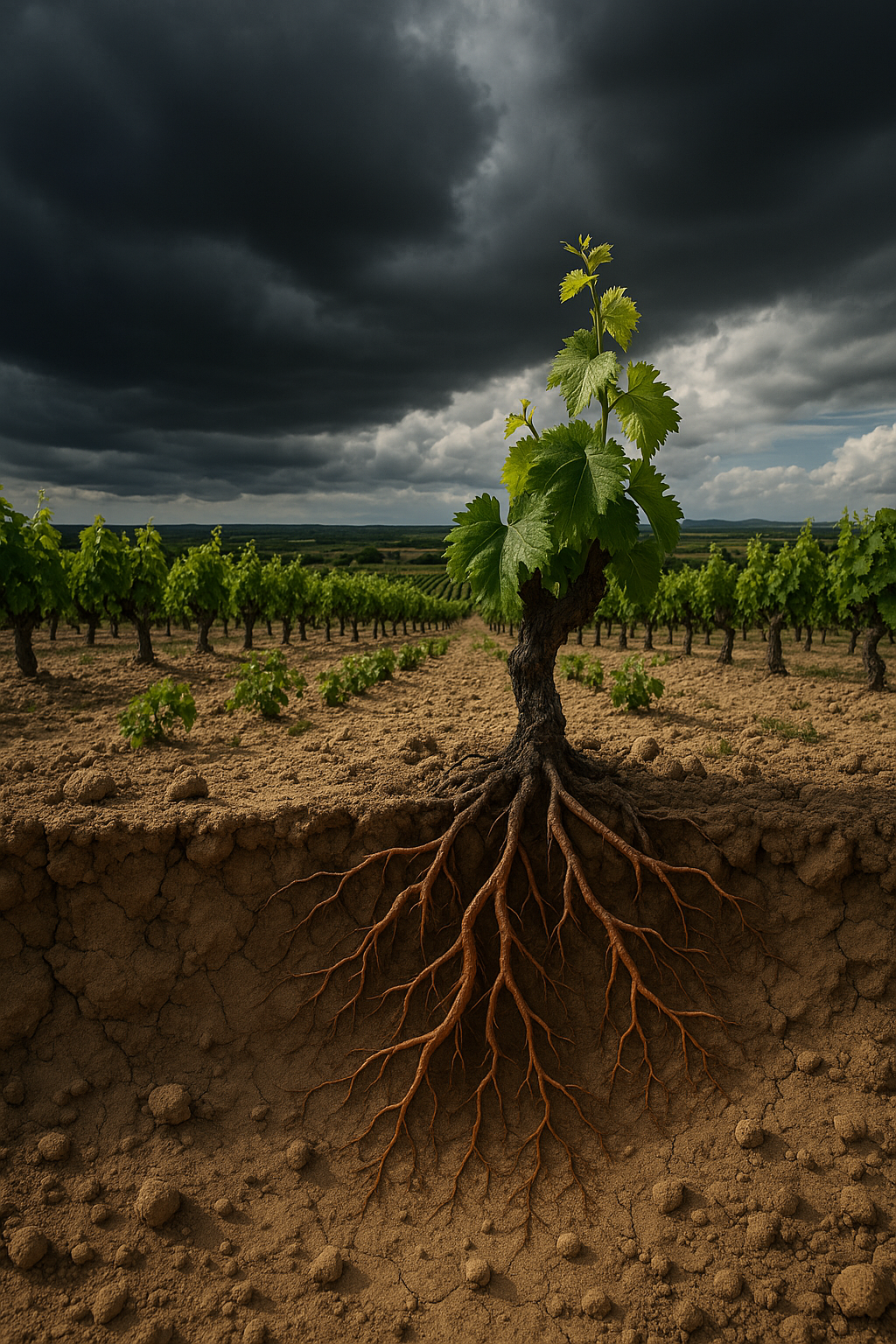
Healthy, resilient vineyards rely on deep-rooted vines. Dry-farmed grapes learn to seek out underground water reserves, making them tougher in drought years. But large-scale producers often irrigate heavily. Their vines never bother to dig deep, so when the tap is turned off in a drought, the vineyard collapses. It’s a short-term fix that leaves vines weaker in the long run. The fact that the irrigated vines have roots that sit closer to the surface also make them more vulnerable to erosion & runoff, frost, weed & pest competition, and soil fatigue - not to mention the obvious - drought and heat. The shallow roots also mean a loss of terroir - the taste of place.
2. Chemicals strip soil of life
Soil should be alive, full of microbes, fungi, and organic matter that store water and protect vines from extremes. In fact, a healthy soil is the first defence in water conservation. Traditional farmers know this. Industrial vineyards, however, rely on excessive pesticides, herbicides, and fertilisers. These strip the soil of its natural resilience, leaving it compacted, eroded, and dependent on even more chemicals to survive. Instead of protecting the vines, the system keeps them locked in a cycle of weakness.
3. Too many eggs (and grapes!) in one basket
Mass-market wine is dominated by just a handful of grape varieties: Chardonnay, Cabernet Sauvignon, Merlot, Pinot Grigio… the well-known "international" grapes. They’re popular, but they aren’t always suited to hotter summers or unpredictable frosts. And, they are being grown everywhere across the globe - not in their indigenous climates, where the environment suits them best. By sidelining local, indigenous grapes, many of which evolved to handle specific climates, industrial wine puts all its eggs in one basket. A sudden pest, disease, or weather event can devastate entire regions that rely on a single variety.
4. A big carbon footprint
Ultra-processed wine is resource-intensive: machine harvesting, bulk shipping across continents, refrigeration, and packaging in heavy glass bottles that rack up transport emissions. This bloated footprint makes these wines not only less sustainable but also more exposed as governments tighten carbon regulations. By contrast, small producers using lighter bottles, local sales, and low-intervention methods are better aligned with a low-carbon future. Drink as “local” as you can.
5. Built for short-term profit, not longevity
Industrial vineyards are managed for maximum short-term yield. Vines are pushed hard, then ripped out and replanted every 15–20 years. Because as vines grow older, they grow better, but their output/yields drop. But some of the world’s greatest vineyards, still thriving after 80 or even 100 years, prove that longevity pays off. Old vines with deep roots produce balanced, resilient grapes year after year. In a warming world, those long-lived vineyards will be the ones that survive. I think I was told once Chateau d’Yquem (Sauternes) yields (≈ 8–10 hectolitres per hectare, sometimes less if the vintage is very difficult), work out to roughly one vine = one bottle of wine (in generous vintages) or even one vine = one glass (in the toughest years)!
Fragile by design
Put simply, Ultra-Processed Wines™ are fragile because they’ve traded resilience for volume. They rely on shallow roots, chemical crutches, monocultures, and quick turnover. In the process, they’ve discarded the very things that once helped vineyards withstand drought, pests, and heatwaves. The good news? Every time you choose a bottle from a small, traditional, or dry-farmed producer, you’re voting for a wine future that can endure. Wines made with care for soil, water, and biodiversity aren’t just better for the planet - they are better for you as well. And they taste better too.
So the next time you’re standing in the wine aisle, remember: resilience is in the roots.
I am very pleased to say that The Wine and Wellness Guide: How to Avoid Ultra-Processed Wines™ is now available for purchase. Convinced that the main driver behind the slump in wine consumption is the mass-market sector, this guide hopes to offer the consumer the knowledge needed to understand the difference between these wines and those that are traditional, organic/bio dynamic, or appellation wines - and all that that entails. Not all wine is created equal.
Thirty years ago, when I was editing a wine magazine in Paris, I watched these “gateway” wines take hold. At this time, there was significant growth in the production and consumption of these more affordable and widely available wines. Driven from the expansion of the wine market in North America and the rise of the New World wine producers, they were welcome - even in Paris.
Back then, they opened the door for new drinkers. Now, they’ve kicked the door off its hinges and taken over the house. Industrial, diluted, sugared-up, high-yield, high-alcohol caricatures of traditional grapes have become the norm.
And when that’s a consumer’s first taste of wine, it’s often their last. We don’t just risk losing a sale, we lose them to another sector entirely.
If the wine world is serious about survival, it’s time to wrestle the “industry” out of the wine industry.
Note: I have no intention of policing my UPW trademark - it is meant to be a talking point and to raise awareness.
Purchase your copy on my site - here (£12 PDF) https://lnkd.in/ggs6CWT5
Or, on Amazon KINDLE (£15.50)

FOR IMMEDIATE RELEASE
Linda Johnson-Bell Secures Trademark for "Ultra-Processed Wines" in Groundbreaking Move to Redefine Wine and Sustainability Conversations
[Oxford, UK – July 2025] – Wine expert, sustainability advocate, and author Linda Johnson-Bell, founder of The Wine and Climate Change Institute, has officially secured the trademark registration for the term "Ultra-Processed Wines", a bold and timely classification that aims to challenge conventional narratives around wine, health, and environmental responsibility.
This trademarked term, now legally protected in the UK, serves as a cornerstone for Johnson-Bell’s upcoming book and ongoing research into wine’s role in health, indigenous knowledge systems, and climate change. By coining "Ultra-Processed Wines," she draws a critical parallel between the industrialisation of the wine industry and the public health crisis linked to ultra-processed foods.
“We’ve learned to avoid ultra-processed foods - now it’s time to apply that same wisdom to wine. Ultra-processed wine is stripped of nutrition, pumped with additives, and engineered for shelf life, not your health. In today’s wellness world, wine is the piranha - once savoured, now shunned. I feel that the UPW™ is a contributing factor to the global decline in wine consumption. What is not understood is that wine is not the enemy, industrial wine is,” says Johnson-Bell. “This trademark is not just a legal milestone - it’s a wake-up call.”
The trademark gives Johnson-Bell the exclusive right to use "Ultra-Processed Wines" in educational, publishing, media, and advocacy contexts, reinforcing her pioneering work in demystifying the production practices of industrial wines and promoting dry-farmed, clean, and sustainable alternatives.
A trusted voice in wine and policy, Johnson-Bell has advised governments, contributed to the United Nations SDG Encyclopedia, and is the author of several books on wine and climate change. Her latest work, set to launch later this year, will delve deeper into how Ultra-Processed Wines impact public health, climate resilience, and cultural heritage, offering consumers the tools to drink consciously and live well.
For press inquiries, interviews, or speaking engagements, please contact:
office@twacci.org
Coming soon …


I write often that wine is a luxury crop: this idea forms the basis for my thesis that freshwater use in irrigation is not viable. But wine used to be grown very differently and in a very different cultural context: usually as part of a European family’s smallholding. Was it ever essential to life? I’ll let you answer that.
Let’s have a quick look at how our luxury crops have changed and evolved. Using cacao, coffee, sugar, tobacco, and wine as my examples, they had very different uses and origins from those that they have today. They were, and still are, an integral part of the indigenous religious and culinary cultures of the Americas and the Caribbean.
First, what is a luxury crop? A traditional definition is that of “a crop that is grown to serve some purpose other than sustaining life”. Luxury crops are non-subsistence crops; many of which were brought from Asia to the Americas by Europeans to be grown as cash crops. In the context of climate change, the definition of “luxury” should be widened to include crops that cannot be grown without employing the most extreme version of the act of farming that surcharges natural resources. They have become unaffordable luxuries. Indeed, one could argue that with the current contortions exerted in manipulating growing environments, staple crops grown as mono-cultures will one day soon become luxury items.
These five luxury crops all have varying quality distinctions. For example, there is a difference between “fine” wine and “bulk” wine, and tobacco leaves undergo intense classifications depending upon their curing and ageing methods. In fact, the quality-dependent attributes of these five crops are strongly analogous: origin/soil, species variety, temperature, climate, rainfall, low yields, and ageing methods are all determinants of the quality of the crops’ end products. If these crops continue to be increasingly grown as cash crops, what then will distinguish them as luxury crops apart from their price? In order to retain their luxury status, they need to be farmed in a ‘luxurious manner’, meaning, eschewing the modern ‘conventional’ farming methods.
Cacao, with its Latin name, Theobroma cacao, translates into ‘food of the Gods’, although the Mayans had a chocolate goddess named Ixcacao. The symbolism of chocolate as blood was universal throughout Mesoamerica. Ritual use of cacao permeates the Maya, Aztec, and other cultures of Mesoamerica. The Aztecs would use cacao to raise the spirits of those about to be sacrificed in elaborate ceremonies. Cacao originally appeared in the Soconusco region of Mexico, with archaeological evidence of its use stretching over millennia. Next to maize, it was the most important plant food in Mesoamerica. Cacao connected mankind to their gods; it was used as a milestone for important life events, and a healing beverage (Seawright 2012). Today, a modern shaman from Ecuador has distinguished the different sorts of energies from cacao’s varying provenances and proclaims that Ecuador’s Arriba Nacional variety (their heirloom variety) has “a pleasant acidity with a touch of salt, carrying tones of the sea” and is best used for connecting to ancestral wisdom (Kara 2018).
Coffee is indigenous to Ethiopia where the locals used the wild plant in sacramental communal ceremonies or to assuage hunger pains during long hunting expeditions. From there it spread across Africa and eventually to Arabia along the trade routes, where, in Yemen, it was made into a drink to accompany their night-time chanting and wailing rituals. A bowl was passed and both men and women would share the potion in an attempt to create meditative stress and transcend to other planes (Topik 2009).
Sugarcane is a tropical grass native to Asia. Brought to the Caribbean by European colonists, the Haitians have long used distilled sugarcane, Clairin, in their ancient voodoo rituals as an offering to ancestral spirits. Made from the juice of locally grown wild sugar cane, the juice is then fermented using indigenous yeast strains before pot-still distillation. It's considered distinct from rum, which is most often distilled from molasses, but it is quite like Martinique's and Guadeloupe's Rhum Agricole, which is also distilled from sugar cane (Bossart 2021).
Tobacco is indigenous to North and South America. In the 1st century BCE, the Mayans used tobacco leaves for smoking in sacred and religious ceremonies and for purification, much like the Native American shaman, who offers tobacco smoke before rituals as an offering to ancestral spirits. Throughout history, tobacco has been used by medicinal herbalists to treat asthma, earache, insect bites, and bowel issues (Mishra 2013). Tobacco smoke, and indeed any plant-based smoke, has long been associated with the sacred purification of space and communication with spirit.
Wine, the Vitis vinifera, is indigenous to the area near the Caspian Sea in southwestern Asia. The Phoenicians and their neighbouring cultures would have consumed wine as part of feasts, funerals, and other sacred ceremonies and communal events. Already, at this point in its early history, it would have been considered a comparatively rare item due to its elaborate and labour-intensive production methods. From here, wine made its way to Greece and to Rome, where it was presided over by the Greek God of Wine, Dionysus and the Roman God of wine, Bacchus. The Romans then brought it to southern France allowing it to spread throughout Europe.
With each of these crops, their regional uses reflected their collective indigenous worldviews. The crops were bequeathed the ability to connect humans to the spiritual world. They were used with the earth representing a deity needing protection and honouring. They were consumed in an environment of reciprocity and solidary in rituals that honoured their ancestors and expressed gratitude to the earth. Their ceremonies highlighted the hierarchical family structure, the learning from and respecting of, elders, and their instinctual need to revere nature and humans over profits (Alderete et al. 2010).
When Western man disconnected himself from Nature, he took these crops with him. When then placed within the Western construct of materialism and individualism, they became items of pleasure to satisfy cravings, as well as becoming commodities and material assets and status symbols, and eventually evolved into social drugs. This puts things into a different perspective, eh? Next time I sit down with my healing after-dinner chocolate, cappuccino, rhum cocktail and light my Partagas, I will certainly offer up a prayer of gratitude to the gods and goddesses!
LJB, Founder, The Wine and Climate Change Institute
The most effective way in which to improve water conservation is to improve soil health. This is one of the aims of both Traditional Ecological Knowledge (TEK) and Regenerative Agriculture (RA). A note: Conservation Agriculture (CA) practices, a subset of Regenerative Agriculture, whilst important, have as their aim to make soil more resilient to climate change events. Regenerative Agriculture goes one step further and has as its aim to renew and restore degraded soil. Soil is the home of water.
The part that soil plays in water management is greatly underestimated and misunderstood. When soil is healthy and retains all the water that it can, then costs go down, and yields increase (naturally) as does income (Hawken 2017 - read his ‘Drawdown’). All soils are composed of the same basic materials: air, water, mineral particles, and organic matter It is the proportions of these ingredients that vary and create the different soil profiles (O’Hare 1988). Decaying organic matter, or humus, is where the water and carbon (60%) are held. Farming practices that assist in protecting and renewing soil health and aid water and nutrient retention are those such as biodiversity, diverse cover crops, diverse and indigenous trees, no-tilling, and no chemicals.

Critical to protecting soil health is allowing it to live in a biodiverse environment. This means having indigenous trees that “act like lungs” (agroforestry). They give shade, provide livestock fodder, act as drought protection, provide firewood, provide leaves for mulch, and aid in soil regeneration (Hawken 2016:119). View trees as assets, as a capital expenditure with healthy returns (Schumacher 2011). Biodiversity allows a natural habitat to function in sync. Every plant will have more than one purpose and will complement the function of its neighbour. An example of what this looks like is Kristen Krash’s cacao plantation in Ecuador.
A biodiverse paradise
I had the pleasure of talking to Kristen Krash and am a great admirer of her work. She is the director of the Sueño de Vida Regenerative Farm in the cloud forest zone of northwest Ecuador. Since 2016, Kristen and her partner Juan have been regenerating degraded land via agroforestry. By implementing time-tested, indigenous methods proven to build soil fertility, create wildlife habitat, and produce optimal yields (as opposed to maximum yields), Kristen and Juan have transformed barren cow pastures into lush and productive secondary forests featuring Ecuador's famed heirloom indigenous cacao variety, Aroma Nacional. According to Krash, weeds, along with banana and plantain, are nature’s pioneer plants because they rapidly cover bare soil and begin performing helpful ecological functions. Weeds jump-start the system by protecting the soil from erosion and replenishing organic matter. Then, by planting different heights of indigenous trees, they produce different heights of canopies that perform different roles thus creating an eco-system where everything has multi-functions. Banana, plantain, and mango are neighbour trees that shelter the cacao from the wind and disease-carrying moulds and keep the soil and undergrowth moist.
“Irrigation can’t do that. Not even drip irrigation can mimic nature and the sort of moisture that is needed” Krash explains. The banana leaves fall to the ground and act as mulch and weed control. Such activity attracts the birds that eat the insects. “All of this is for free, and I don’t need pesticides, fertilisers, or herbicides” (Krash 2022). She laments the idea of there having been acres of cow pastures on her land before she bought it. “What about crop suitability? What was a cow pasture doing in a subtropical rainforest? They need a meadow or a savannah” (Krash 2022). Further, she then plants turmeric and cardamom under the cacao, creating a three-tiered system that creates additional revenue streams. This is reminiscent of the Native American “Three Sisters” system where corn, beans, and squash are grown together. The corn stalks hold up the beans and the squash is ground cover and eventually, mulch.
Crop Suitability as a resource manager
Biodiverse, indigenously planted, regenerative, and organic farming systems are the solution to sustaining ecological and economic wealth. These systems use ten times less water than chemical systems (Shiva 2016). Another farming practice that substantially contributes to a healthy and sustainable ecosystem is crop suitability. This term is often absent from the narrative or coupled with the discussion on indigenous plantings. Crop suitability is about matching a plant to its optimal ecological habitat. Nature does this easily for us: Vitis vinifera is indigenous to southwest Asia near the Caspian Sea, nestled in the Caucasus mountains. Having wandered far from home, the grapevine is still most suited to a relatively narrow geographical and climatic range; most often in mid-latitude regions that are prone to high climatic variability (between 30 degrees NS and 50 degrees NS latitude). But when brought overseas to the much warmer and drier climates of the New World, and subjected to the mechanisation of chemical conventional farming, the plant struggles. Cacao is native to the Amazonian rainforests and prefers a temperature between 18-32℃ with no direct sunlight or winds, yet today, half of the world’s chocolate is grown in Africa, in Ghana, and on the Ivory Coast. Sugarcane is native to tropical Asia yet is also grown in sub-Saharan Africa. Tobacco is indigenous to Argentina, yet the world’s largest producer is China. Even rice paddies are being grown in California’s Sacramento Valley, with flood irrigation.
The act of growing crops outside of their natural habitats is taking them out of their self-sustaining system. When they are taken out of these systems and grown as a monoculture, this false habitat then has to be manufactured for them, disrupting whichever ecosystem to which they have been moved. They can pose a threat to the indigenous species in the displaced habitat. (Vandana) Shiva provides a good example of this. The story of sugarcane in India in the 1970s began when the World Bank subsidised mechanical water withdrawal systems which ushered in an explosion of sugarcane plantations in Maharashtra just as it was hit hard by drought. The sugarcane fields literally converted groundwater into a commodity and left people and staple food crops thirsty for water. Sugarcane is only cultivated in 3% of this district but consumes 80% of the irrigation water and eight times more than other irrigated crops. Ironically, as the state was struggling with famine, the sugarcane sector was flourishing. Today, the water is gone (2016).
Fundamentally, one can say that Traditional Ecological Knowledge finds its origins in crop suitability. In the past, indigenous cultures predominantly consumed what was grown where they lived with additional forays into small-scale crop cultivations within a biodiverse system. The ecological unbalance was triggered not so much when cultivation commenced, but rather, when cultivation of non-indigenous crops became the dominant system, and this system was then further subjected to both intensive and chemical farming methods.
LJB, Founder, The Wine and Climate Change Institute

LJB, Founder of The Wine and Climate Change Institute, www.twacci.org
“The Porto Protocol Foundation is an international non-profit institution, founded by Taylor Fladgate Port, with hundreds of other members committed to making a greater contribution to mitigating climate change. Born in the wine industry and spread across the whole value chain, we strive to be a catalyst of climate action. Our belief is that, if we share our successes and experiences, our response to climate change will be more effective. We are a community of practice, an open platform, a dynamic database of resources and workable solutions, a place of inspiration for change and collaborative sharing. Porto Protocol has been awarded the prize for best Green Initiative by The Drinks Magazine Green Awards 2020.”
VISIT THEM : https://www.portoprotocol.com/

LJB, Founder, The Wine and Climate Change Institute
All sources are cited on the TWACCI site for easy reference.

LJB, Founder, The Wine and Climate Change Institute
Please feel free to contact Linda on: author@thewinelady.com.